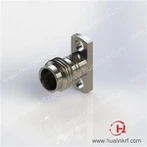
RF connector is a larger category in the connector, but also the core product, how much do you know about the RF connector connector connector, do you know which connectors are included in the RF connector? If you don't have any ideas about this problem, read this article.

Coaxial connectors, which are also coaxial connectors and coaxial cable interfaces, refer to parts used to connect the ends of two axes to ensure that the center lines of the two axes are on the same axis. Coaxial connection heads are available in connection applications, and each coaxial connection head is designed for specific purposes and applications. In general, RF connectors contain 16 main connectors, as follows:
1, BNC connection head, commonly known as Q9 head, referred to as BNC head
BNC connection head (Bayonet Navy connector), full name Navy bayonet connection head, initially mainly for military purposes, has been widely used in video and radio frequency, its most typical coaxial connection head, the port connection to ensure fast connection, reliable contact. The BNC head is a conveniently installed and inexpensive common coaxial connector that can operate at frequencies up to 2GHz and above 4GHz, with slotted signals. The threaded connection type, the TNC connector (also for the threaded BNC connector), solves the problem of signal leakage, and the TNC connector can operate at up to 12GHz. BNC connection heads are currently commonly used for two characteristic impedances, 50 and 75 s.
The BNC connector has many new structures according to actual needs, such as triaxial BNC head, dual-axis BNC head (Twinax BNC), BNC-R connector, etc., and the three-axis BNC head is mainly used to transmit small signals.
2, N-type connection head
The N-joint (Navy) is a threaded connection that emerged in 1940 and is mainly used in military systems below 4GHz; Improvements were made in 1960 to increase the operating frequency to 12GHz and then to 18GHz, commonly used as 50o, and some 75o products are also N-shaped, with smaller inner conductor diameters and incompatible connection heads of 50 S. N-type connector is a threaded connection of the medium-power connector, with high reliability, strong vibration resistance, mechanical and electrical performance and so on, widely used in vibration and environmental conditions of radio equipment and instruments, and ground transmission system connected to RF coaxial cables.
3, APC-7 connection head, but also 7mm connector
The APC-7 (Amphenol Precise Connector-7mm) has the lowest reverse coefficient and the best repeatability in measurements in connectors with frequencies up to 18GHz, and was developed by HP and Amphenol in 1960. This connector is not negative or positive and is considered the best connector in practice and is particularly suitable for metering and calibration.
4, APC-3.5 connection head, but also 3.5mm connection head
The 3.5mm connection head was developed primarily by HP and was produced by Amphenol in the early days. This connector is designed to be the same size as the usual SMA connector, while the physical interface is robust and can operate at up to 34GHz.
5, APC-2.92 connection head, but also 2.92mm connection head
The 2.92mm connector head is in line with the SMA connector and the 3.5mm connector in size and can operate at up to 40GHz.
6, APC-2.4 connection head, but also 2.4mm connection head
The 2.4mm connector head was developed by HP, Ampheenol and M/A-COM and operates at 50GHz. The connectors are designed to increase the thickness of the outer wall and enhance the negative pins, making them less prone to damage than SMA joints and 2.92mm joints. With the precision adapter, the connector can be paired with connectors such as SMA, 2.5mm and 2.9mm. The 2.4mm connector has three product grades: universal, instrument and metered. Versatile for use in components, cables and microbelts for situations where connections are infreet, repetitive and low-cost requirements. The instrument type is best suited for use in measurements, where repeatability and long life are the primary considerations. The metering type is best suited for calibration, where the performance and repeatability of the connectors are the highest.
7, APC-1.85 connection head, but also 1.85mm connection head
The 1.85mm connector was developed by Agilent in the mid-1980s and operates at frequencies up to 60GHz. To support the standardization of the connector, Agilent made the design of the connector public in 1988. The 1.85mm connector head and the 1.4mm connector head can be connected to each other at the same strength. Many experts believe that this joint is the smallest of the coaxial connectors operating at frequencies up to 60GHz.
8, APC-1 connection head, but also 1.0mm connection head
Designed to transmit signal frequencies up to 110GHz, this 1.00mm connector is flexible and reliable when connected to each other and is the result of remarkable achievements in precision manufacturing.
9, SMA connection head
The SMA connector is a small head (Subminiature A), designed by Bendix Scintilla, one of the most common RF microwave connectors, with a compact, durable threaded connection and a DC-18GHz frequency. These connectors are mainly used in semi-steel cables and fixed-attached components. Because SMA's media support is difficult to secure, most SMA connection head reverse coefficients are larger than other connection heads that can be used for 24GHz, connecting nuts to meet the connector requirements of high vibration environments.
10. SMC connection head
The SMC connector, known as Subminiature C, is much smaller than the SMA connector and is ideal for use when space is limited, leaks are small and rounded, and the operating frequency is typically up to 10GHz, commonly used for signal transmission, such as shock-proof automotive GPS and communications.
11, SMB connection head
The SMB connector, known as Subminiature B, is a plug-in or snap-in connection compared to the SMA connector, rather than a threaded connection, making connection and disconnection quick and easy. Operating frequencies typically up to 4GHz are commonly used for data signal transmission, such as digital cellular, GPS, and wireless LAN.
12, MCX connection head
THE MCX CONNECTOR (MICROAX COAXIAL CONNECTORS) IS A PUSH-IN SMALL, COMPACT, EASY-TO-CONNECT RF COAXIAL CONNECTOR. The MCX connector features a resistance of 50 and 75 degrees, making it suitable for use in tight spaces and lightweight places, and is 30% smaller than the SMB connector. Operating frequencies typically up to 6GHz are commonly used for data signal transmission, such as GPS antennas and RF instruments.
13, MMCX connection head
THE MINIATURE MICROAX COAXIAL CONNECTOR IS A SMALL COAXIAL CONNECTOR THAT IS SMALLER THAN THE MCX. With a latch-type connection, it can be turned 360 degrees, making it suitable for applications where small form factors and light weight are required. Operating frequencies typically up to 6GHz are commonly used for data signal transmission, such as GPS antennas and PCMCIA cards.
14, DDF side commonly used coaxial connector, L9 (1.6/5.6), commonly known as Siemens coaxial head
Named because of the coaxial connector used in the Siemens DDF frame. With threaded locking mechanism RF coaxial connector, the connection size is M9 x 0.5. The conductor contact material of the L9 connector is palladium bronze and tin phosphorus bronze, and the gilded thickness of the conductor contact area inside the connector is not less than 2.0 microns. L9 is a domestic name, internationally known as 1.6/5.6 coaxial connectors. L9 head commonly has 3 specifications, the main difference is that the cable caliber used together is different.
15, AV lotus head RCA
16, anti-polar coaxial connector