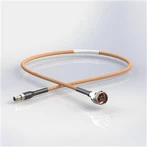
How much you know about coaxial cable products, below, will introduce you to the structural characteristics of coaxial cables and its development of a brief history, I hope our insights, can help you understand coaxial cable products.
Coaxial cable structure features:
Coaxial cables consist of internal conductors surrounding the insulator and metal shielding nets outside the insulation layer and sheaths of the outermost layer. The metal shielding net of this structure prevents the center conductor from radiating the electromagnetic field outwards, and can also be used to prevent the external electromagnetic field from interfering with the signal of the central conductor.
A brief history of the development of coaxial cables:
The first generation coaxial cable: a coaxial cable with solid core polyethylene material as an insulating medium
Features: Simple process, large attenuation.
Second-generation coaxial cable: a coaxial cable with chemical foaming polyethylene material as an insulating medium
Features: foaming degree of less than 50%, and there are chemical foaming agent residues, affecting dielectric properties.
Third-generation coaxial cable: a coaxial cable with core perforated polyethylene material as an insulating medium
Features: Attenuation is lower than the previous two generations, but the erythema is prone to water seepage, foreign regulations for its service life of five years.
The fourth generation coaxial cable: a coaxial cable with physical foaming polyethylene material as an insulating medium
Features: foaming degree of up to 80%, attenuation is very small, microporous closed, stable performance, long service life.